



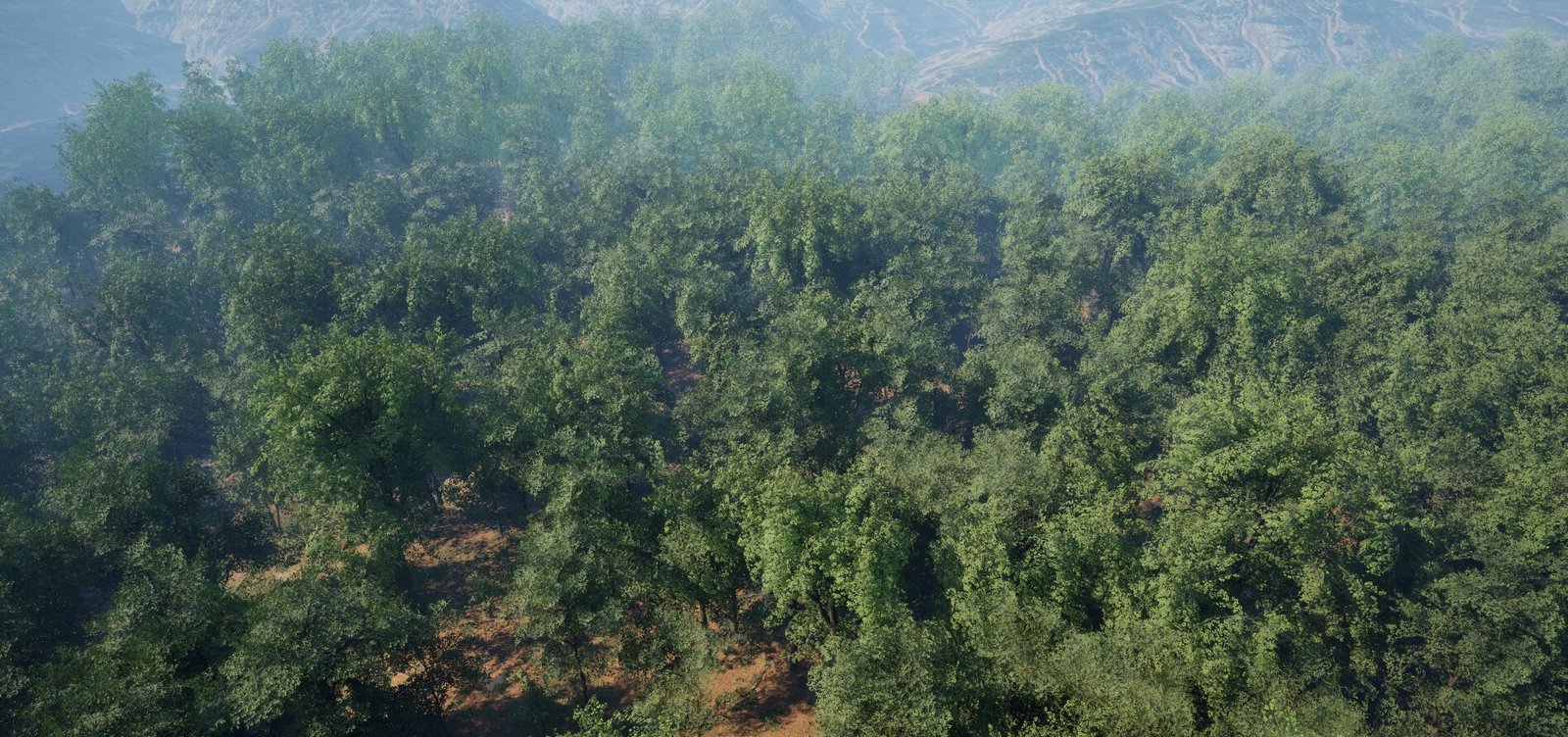
Imagine a drone flying low over a mountain forest. It climbs as the ground rises and uses laser beams (lidar) to scan the trees below.
The forest isn’t real. Researchers at the University of Cambridge built this whole landscape inside a computer using a video game engine. Their goal was to teach artificial intelligence how to spot individual trees.
Being able to tell one tree from another is important. It helps scientists measure how forests grow, how they react to climate change, and how much carbon they store. In the past, researchers had to carefully draw outlines around thousands of real trees by hand to train the computers. That work could take weeks.
Cambridge PhD student Yihang She created a better way. He built a training simulator that creates forests automatically and already knows which points belong to which tree. The study, along with a free toolkit called CAMP3D, was published in the International Journal of Computer Vision.
“In forest surveying, data collection itself isn’t the hard part; the hard part is cleaning and labeling that data,” he said. “Without accurate individual-tree segmentation, none of the downstream work is possible. That’s where this study fits into the bigger picture.”
Drones with laser scanners have made it much easier to survey large or hard-to-reach forests. But computers still find it difficult to separate one tree from the next in the data. Training them usually needs a huge amount of carefully labeled real examples.
In She’s method, the trees are already labeled because they were made by the computer. The team used Unreal Engine (the same software used to make many video games) to grow virtual forests. Then they flew a simulated drone with a simulated laser scanner over them. The result is a 3D map that is fully labeled from the start.
When this model is tested on real forests, researchers only need to label about 2–3% of the trees that older methods required. The simulator-trained system worked just as well as one trained on a complete set of real labeled data.
The idea came from self-driving car research. While looking for real forest data, She noticed that car companies were already using game engines to create endless practice situations for their AI.
“My supervisor showed me some vegetation examples from CARLA [a self-driving-car simulator also built on the Unreal Engine] and the thought was: maybe we could generate some data from this,” he said.
The researchers combined Unreal Engine with a realistic laser simulator called HELIOS++ and released everything as a free open-source toolkit named CAMP3D on GitHub.
Andrew Blake, a professor emeritus at Cambridge and an early pioneer in computer vision, praised the work.
“Yihang has done a beautiful piece of work here in vision simulation. It’s a wonderful modern tool for AI-driven research in forest ecology, and it should be widely reusable,” Blake said.
The team has already taken the next step. Instead of lasers, they now simulate how light and radio waves bounce off forests the way a satellite would see them. This lets them test and better understand large AI models that study the Earth from space, such as Cambridge’s Tessera model.
“It opens up the possibility of designing controlled simulations to probe what geo-foundation models have learned about physical concepts,” he said.