



Demand is driven by electrification across all verticals, as OEMs adapt to this sustained pressure by adding more flexibility at the design stage
We are in a renewed growth phase for power semiconductors. The headline application is, of course, artificial intelligence, and the biggest impact of this unprecedented demand has been to the price and availability of high-bandwidth memory. But data centres are also huge consumers of power, which is causing its own disruption. The demand for more electricity in general, as the primary energy source in more vertical markets, is increasing rapidly.
While the huge demand for memory is causing significant problems for suppliers and OEMs, the growth in power isn’t creating a uniform shortage across every device family. We’re seeing a divergence in demand, driven partly by new applications and partly by a return to growth in established verticals.
The main drivers for the demand for power semiconductors are electrification and higher power density. Both these drivers are present across the board, from the relatively new to the well-established vertical markets: AI data centres, EVs and charging, renewable generation, battery energy storage and grid modernization. A recovering industrial market is also generating growth.
Each of these applications increases the need for efficient power conversion, protection, sensing and control. In AI infrastructure, rack-level power consumption is rising sharply, pushing demand for high-efficiency ac-dc supplies, 48/50V or HVdc distribution, multiphase regulators, PMICs, hot-swap devices, current sensing, high-current passives and, increasingly, SiC and GaN.
Power architectures tied to AI data centres
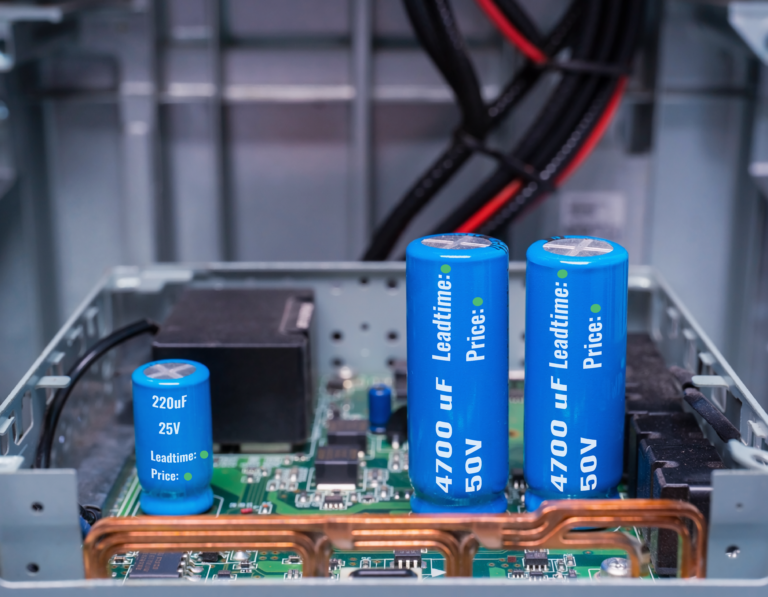
Energy and transport, solar, storage, EV chargers and 800 V vehicle platforms are all big consumers of IGBTs, silicon MOSFETs, SiC MOSFETs and diodes, gate drivers, DC-link capacitors, magnetics and thermal-management components.
The result is a two-speed market. The fastest-growing side is made up of power architectures tied to AI data centres, high-voltage EVs, EV charging, renewables, storage, grid equipment and advanced power management. These markets are being pulled by structural demand: hyperscale AI capital expenditure, higher rack power, public charging buildout, growth in solar and battery installations, and investment in transmission, HVDC and grid-forming systems. Supplier evidence supports this, showing demand moving into revenue, product roadmaps and design activity.
Balance should shift as AI power architectures mature
The slower side shouldn’t be seen as weak demand but digestion after a correction. Some legacy automotive and industrial demand remains uneven, and SiC is working through the effects of the 2019 – 2024 capacity-investment cycle, though long-term forecasts remain positive. That creates a market in which distributors and suppliers can see strong demand in AI power, storage, grid and selected EV platforms while still seeing softer pricing, excess inventory or longer absorption times in parts of the SiC supply chain.
Over the next few years, the balance should shift further toward the high-growth side as AI power architectures mature, 800 V EV platforms gain share, charging capacity expands and grid/storage investment continues. Analysts expect a broader semiconductor upcycle with sustained power-electronics and SiC growth into the next decade.
Near-term demand will therefore remain selective, but the medium-term direction is clear: more power conversion, higher voltages, greater efficiency requirements and more semiconductor content per kilowatt across data centers, vehicles, energy infrastructure and industrial systems.
Supply chain resilience starts at the design stage
There is strong evidence to show that OEMs are explicitly avoiding single-source dependency, particularly in power electronics. Many suppliers support this through multi-source design notes and cross-reference guides. The Point-of-Load Alliance (POLA) and Distributed-power Open Standards Alliance (DOSA) are good examples of how this works in practice. But the truth remains that ‘pin compatible’ does not validate the part in a design.
The 2020 – 2023 component shortage put alternative sources on the executives’ agenda. Power engineers are now treating alternate sourcing as a design input rather than a purchasing workaround. Pre-planning can ensure components with no second source are avoided at the design stage, while identifying alternatives that need engineering approval earlier in the lifecycle.
Choosing software-configurable power components is also becoming more common. Programmable PMICs and digital power controllers can’t always become true second sources, but they can be used in sub-assemblies that allow one hardware platform to serve multiple products. This can enable features such as dynamically configuring output voltages, changing the startup sequencing and providing more flexible low-power modes.
For power supplies with commodity rails, engineers can treat substitutability as a layout constraint by choosing common packages, validating pin-to-pin compatibility and adding topology flexibility. For example, including optional feed-forward capacitors or selectable feedback dividers could allow one design to accommodate alternate buck converters or LDOs.
For power MOSFETs, having the same package is a good starting point. For power modules, POLA and DOSA footprints are an advantage when time-to-market and lifecycle continuity are important. If your design uses a lot of PMICs the best approach may be architectural flexibility rather than looking for equivalent parts.
Advanced power stages are a lifecycle risk
The risks associated with advanced power stages center on availability, with pricing secondary. Shortages, lead time, allocation and second sourcing are foremost. These are often obscure to OEMs unless they work with a distribution partner that has strong supplier connections. Price risk can be mitigated through design registration and cost modeling, to gain distributor agreements that secure supplier price protection.
High-mix distributors offer the broadest choice of power products in low volume. This gives development teams options, providing the opportunity to employ the techniques discussed earlier. Comparatively, high-volume distributors work with their supplier partners to identify trends and mitigate potential supply chain issues long into the foreseeable future.
By working closer from the start of a project, distributors’ FAEs can provide bill-of-material (BoM) and schematic reviews to reduce supply chain risks further down the product lifecycle. This is the advantage high-volume distributors have over the high-mix, low-volume distributors.
Engaging with distribution earlier in the design process also means you are no longer reacting to power component shortages or firefighting procurement issues. You are creating design touchpoints precisely when they are needed; before the design is locked into specific parts.
Consulting with your distribution partner before freezing your schematic means you identify lead time and lifecycle pinch points. More importantly, engineering teams get access to supplier roadmaps that align with their own product development schedules.
Conclusion
Power electronics demand is not rising evenly, but the direction of travel is clear. AI infrastructure, electrified transport, charging networks, renewable energy, storage and grid modernization are all increasing the need for efficient power conversion, higher-voltage architectures and more semiconductor content per kilowatt. At the same time, uneven supply conditions, legacy inventory corrections and limited second-source options mean availability will remain a design and lifecycle concern, not just a procurement issue.
For OEMs, resilience starts before the schematic is frozen. Designing with sourcing flexibility in mind, validating alternatives early, understanding supplier roadmaps and identifying lifecycle pinch points can reduce exposure to allocation, lead-time and pricing pressure later. As power architectures become more specialized, the strongest position will come from combining engineering insight, broad component access, supplier visibility and production-scale supply chain support from concept through to volume manufacture.