






Introduction
This section provides an overview of resonator fundamentals and highlights the MEMS-based SiTime Titan Platform™ as a key solution for wearable and IoT endpoint devices.
A resonator establishes the timing foundation for electronic systems by determining the seed clock frequency of a reference oscillator. The reference oscillator’s output is a clock used by processors, wireless modules, and sensors. Although quartz crystal resonators are found in many legacy applications, they introduce size, power, reliability, and integration constraints that limit design flexibility for wearables and IoT devices.
The SiTime Titan family of MEMS resonators address these limitations, lowering power consumption by 50% and enabling the industry’s smallest resonators with sixth-generation FujiMEMS technology. The 0505 chip-scale package (CSP) measures 0.46 × 0.46 mm and reduces PCB area by 7× compared to the smallest 1210 quartz package at 32 MHz—and 4× compared to the smallest 1008 quartz options at higher frequencies. Notably, the initial five Titan resonators support key frequencies for BLE/Bluetooth, microcontrollers (MCUs), and a broad range of wireless system-on-chips (SoCs).
Titan also improves robustness and reliability with up to 50× greater shock and vibration resilience and up to 50× higher mean time between failures (MTBF). In addition to the CSP package, Titan resonators are available as known good die (KGD) for co-packaging inside SoCs and MCUs, thus eliminating the discrete timing component from the PCB.
This pillar piece highlights Titan’s role in wearable and IoT timing architectures. It reviews application requirements, details the platform’s size, power, and integration advantages, and outlines its PCB and co-packaged implementation pathways. A final FAQ section discusses common design questions related to frequency options, environmental resilience, long-term stability, and migration from quartz to MEMS resonators.
Section 1: Application Requirements and Design Challenges
This section outlines the timing demands of wearable, medical, and IoT devices, reviewing the constraints engineers face when designing compact, battery-powered systems.
Smartwatches, fitness bands, and smart rings depend on compact timing solutions to maintain frequency accuracy despite physical activity and temperature variability. These devices operate within tight space constraints and require timing components that support stable wireless links and consistent system performance.
Medical devices demand even greater reliability and power efficiency. Hearing aids, continuous glucose monitors (CGMs), and implants routinely operate for extended periods on small batteries. These platforms rely on timing solutions that must be seamlessly integrated into miniaturized system architectures without compromising stability or long-term performance.
IoT endpoints introduce additional constraints. Sensors, asset trackers, and smart labels often operate in variable or harsh environmental conditions and need precision timing solutions to maintain accuracy while minimizing power consumption. Many rely on coin cells or energy-harvesting sources, which increases the importance of low oscillator power and fast startup characteristics.
Across these categories, engineers must allocate limited PCB area among timing components, sensors, radios, batteries, and other supporting circuitry. Shock and vibration resilience is essential, as mobile, wearable, and portable systems experience repeated movement and impact that can degrade timing accuracy in less robust resonator technologies.
Wireless connectivity adds another layer of design complexity. Protocols such as Bluetooth/BLE, UWB, and Wi-Fi use specific reference frequencies that vary by SoC vendor. Each protocol mandates the required frequency stability of the resonator to ensure wireless interoperability and radio performance. Resonators exceeding these specifications offer engineers more flexibility to develop products that operate across a wide range of real-world conditions.
Section 2: Quartz Resonator Limitations and the SiTime Titan Platform™ Breakthrough
This section builds on the requirements discussed in the previous section, reviewing resonator fundamentals and highlighting the Titan Platform as a solution with measurable advantages in size, power, stability, resilience, and reliability.
Quartz resonators have long provided the frequency-setting element for oscillator circuits, yet their ceramic packaging and legacy manufacturing processes limit size scaling and restrict integration flexibility. These constraints increase power consumption, complicate board layout, and reduce long-term reliability in compact, battery-powered systems.
The Titan Platform introduces a new approach to resonator design and integration based on sixth-generation FujiMEMS technology. Titan resonators measure 0.46 by 0.46 mm in a CSP package or in die form, supporting both traditional PCB-mounted implementations and co-packaged designs.
Quartz resonators rely on ceramic packaging to protect the quartz mechanical element and meet their specifications. In contrast, Titan devices utilize hermetic sealing during MEMS wafer manufacturing to maintain stability and long-term reliability. Eliminating a separate package enables Titan CSP and bare die in a significantly smaller size.
Moreover, manufacturing Titan in a silicon wafer clean room prevents impurities, resulting in superior aging performance compared to quartz resonators. The resonators are also factory-programmable, allowing designers to match varied load capacitance requirements across SoCs and MCUs without redesigning the oscillator environment.

Additional key features and benefits include:
- Compact form factor: Reduces PCB area by 7× compared to the smallest 1210 quartz resonator at 32 MHz—and by 4× compared to the smallest 1008 quartz options at higher frequencies. The resulting PCB savings frees up space for sensors, antennas, additional battery capacity, or improved routing.
- Lower oscillator circuit power: Supports oscillator power consumption reduction by up to 50%, delivers startup times up to 3× faster, and reduces startup energy by 3×, extending battery life in portable and wearable designs.
- Reliable operation: Operates from –40 °C to +125 °C with tighter frequency stability than quartz across the full operating range. Achieves 5× better aging performance, specified over five years of continuous operation at the maximum rated temperature (which is the most challenging condition for aging).
- Shock and vibration resilience: Withstands shock and vibration up to 50× better than quartz and delivers MTBF up to 50× higher, based on the field performance of more than 4 billion shipped MEMS timing devices.
- Compatibility: Works with existing oscillator circuits in current SoCs and MCUs, enabling direct migration from quartz-based designs.
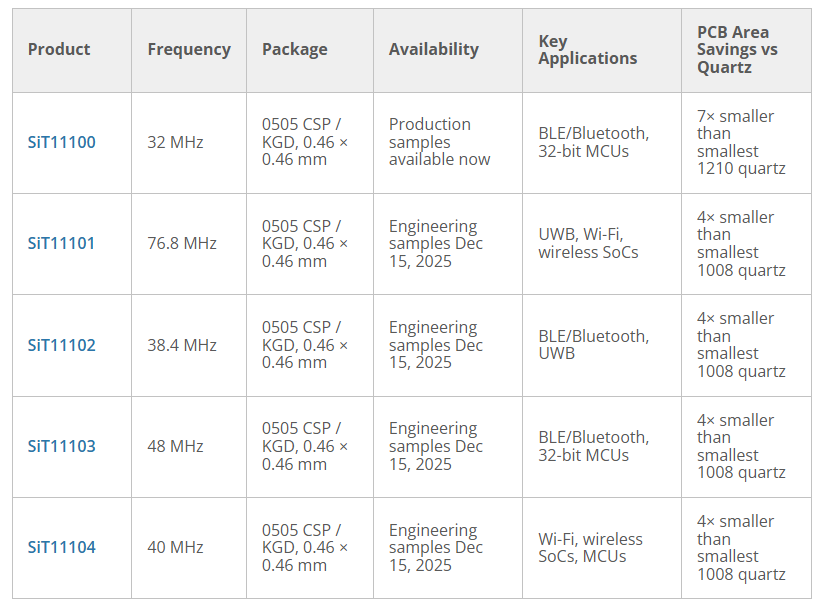
The initial Titan product family spans five key frequencies. The 32 MHz device has production parts available and is finalizing qualification. Initial engineering samples for the 38.4, 40, 48, and 76.8 MHz variants are also available. These devices support 32-bit MCUs, BLE/Bluetooth SoCs, and higher-bandwidth protocol SoCs such as UWB and Wi-Fi. The table below summarizes the full product family, highlighting package formats, availability, and key application targets.
Section 3: Integration Strategies and Implementation Pathways
This section outlines pathways for integrating Titan resonators—from PCB-mounted to co-packaged designs—and summarizes the key resources that support design, validation, and scalable production.
Titan resonators support multiple integration pathways, enabling designers to adopt MEMS timing in both existing and next-generation architectures. The simplest approach uses PCB-mounted components that drop in as direct replacements for quartz resonators and follow standard surface-mount assembly and reflow processes. Because the Titan footprint requires far less area than quartz, layout changes are minimal and straight-forward. The recovered board space can accommodate additional components or facilitate cleaner routing with fewer compromises. This approach maintains the electrical behavior of the original design while improving size, power, and reliability.
The 0.46 × 0.46 mm CSP package footprint provides added placement flexibility and reduces congestion around radio, sensor, or antenna circuitry. Titan is also available in KGD bare-die format to support co-packaging inside SoC and MCU packages during semiconductor assembly. Co-packaging uses wire-bond or flip-chip methods and removes the resonator from the PCB entirely. This approach frees two pins from the MCU/SoC package, which can be repurposed as additional GPIOs to provide enhanced system functionality.
Beyond physical integration, Titan devices maintain electrical compatibility with oscillator circuits used in current SoCs and MCUs and operate without additional components or circuit changes. Their near-zero shunt capacitance allows designers to target lower load capacitance than is feasible with quartz, reducing steady-state current consumption. Optimized Q values further improve startup behavior, enabling startup times up to 3× faster than quartz and consuming up to 3× less energy from the battery during each startup cycle. These factors help extend battery life, which is especially important in wearable products and IoT endpoint devices with coin cell batteries.
Additional key features and benefits include:
- Factory-programmable load capacitance with 0.5pF resolution: Matches SoC and MCU requirements, streamlining inventory management and reducing design cycles due to shorter lead times than quartz resonators. The latter requires full manufacturing time when changing the load capacitance value.
- Standard semiconductor manufacturing flows: Utilizes established semiconductor industry manufacturing infrastructure and standard wafer-level CSP packaging processes.
- High-volume scalability: Increases die-per-wafer counts through a small die size, supporting large consumer, IoT, and wearable production volumes.
- SiT6400EB interposer evaluation board: Accelerates validation by enabling direct performance comparison and testing on existing PCBs designed for 1210 and 1612 quartz footprints.
- Comprehensive design resources: Includes datasheets, layout and assembly guidelines, 3D STEP models, the Titan Frequency Trim Calculator Tool, behavioral SPICE models, and reference layouts.