


Siemens and Rittal have announced a strategic partnership aimed at redesigning power distribution infrastructure for next-generation data centers. The collaboration focuses on addressing the rapidly increasing power demands driven by AI workloads while accelerating the deployment of high-performance facilities.
The companies plan to develop standardized infrastructure for the IEC market that can support future data center architectures. For engineers and infrastructure designers, the partnership highlights how power distribution is evolving to handle dramatically higher rack power densities and faster deployment cycles.
Tackling rising AI power densities
AI workloads are pushing data center infrastructure to new limits. Power densities exceeding 100 kW per rack are already common in AI facilities, and the companies say this could climb to more than 1 MW per rack by 2030.
Meeting these requirements will require new approaches to power distribution, cooling and heat recovery. Siemens Smart Infrastructure is bringing its experience in electrical power distribution, while the Friedhelm Loh Group — through its Rittal brand — contributes expertise in racks and standardized infrastructure for hyperscale environments.
“We have a long-standing collaboration with Siemens in a number of fields. We are proud to be taking our partnership to the next level,” said Prof. Dr. Friedhelm Loh, owner and CEO of the Friedhelm Loh Group. “Both companies are driven by the desire to innovate. As technology leaders, we have a responsibility to keep strengthening our customers’ competitiveness with the latest technologies.”
“Sidecar” rack aims to simplify power delivery
One of the first developments from the partnership is a next-generation “sidecar” power rack that sits directly in the white space of a data center alongside server cabinets.
Instead of distributing power through traditional infrastructure paths, the concept consolidates power electronics in a dedicated rack that directly supplies nearby server racks. According to the companies, this architecture enables faster deployment while supporting standardized and scalable power delivery.
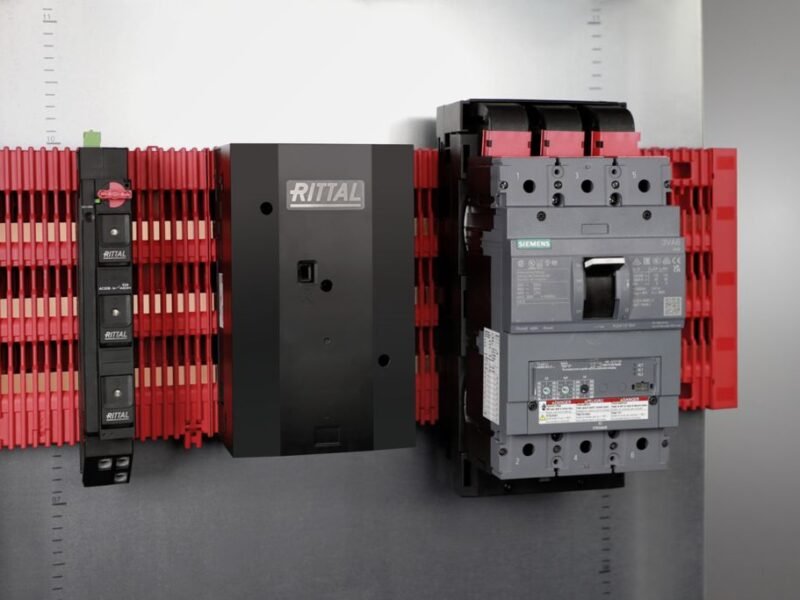
The system is based on Open Compute Project (OCP) standards and uses modular technologies from both companies. Siemens electrical components are combined with Rittal infrastructure platforms such as RiLineX and Ri4Power to create a solution intended to maximize performance efficiency, including tokens-per-watt for AI workloads.
“To enable the rapid growth of AI, we need smart, reliable, and scalable power supply solutions for data centers and we need them quickly. In combination with our innovative electrical products and solutions, Rittal is an ideal partner when it comes to speed and standardization in infrastructure,” said Andreas Matthé, CEO Electrical Products at Siemens Smart Infrastructure.
Broader infrastructure plans underway
Beyond the sidecar concept, Siemens and Rittal are also developing a standardized low-voltage distribution system for modular and containerized data centers. In addition, work will focus on improving operational safety and protection for personnel working within high-density facilities. The companies say the first customer projects based on the joint developments are already underway.
Looking ahead, the partnership could extend beyond data centers into other industrial and infrastructure applications where scalable and standardized power distribution is becoming critical.