


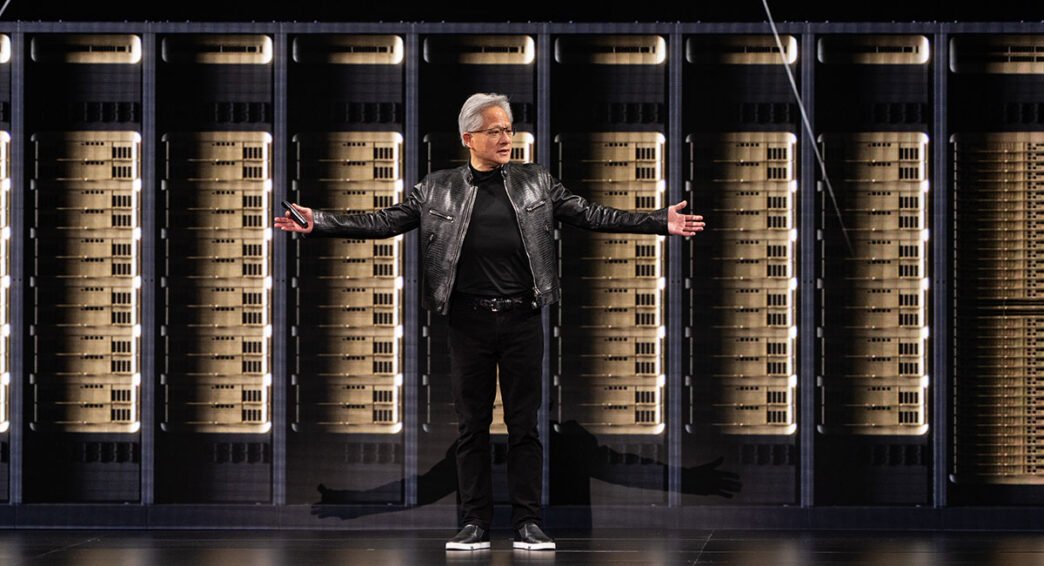
The era of passive, text-generating artificial intelligence is officially over. At Computex 2026, NVIDIA CEO Jensen Huang declared a major shift in the tech landscape: the rise of Agentic AI.
NVIDIA is no longer just manufacturing the silicon chips that power the cloud; they are building the autonomous, hyper-personalized software ecosystem of the future. With the launch of the NVIDIA Agent Toolkit, OpenShell, and RTX Spark, AI is moving out of distant data centers and into our personal, everyday hardware.
The age of the personal AI agent has arrived—and it is deeply personal.
What is Agentic AI? (And Why It Matters)
To understand this shift, we need to define how software is evolving. Traditional generative AI is reactive; you give it a prompt, and it outputs text, code, or images.
Agentic AI refers to autonomous software systems that don’t just reason or generate content—they take action.
Equipped with the ability to reason, navigate local data, and call external tools, an AI agent can execute multi-step workflows without constant human hand-holding. If a traditional chatbot is an assistant waiting for dictation, an AI agent is a specialized partner tasked with achieving an objective.
Building the Personal AI Ecosystem: The Core Tech
NVIDIA’s 2026 announcements outline a comprehensive, full-stack architecture designed to bring these capabilities directly to consumer and enterprise hardware.
1. RTX Spark: The On-Device AI Powerhouse
NVIDIA introduced the RTX Spark, a cutting-edge Windows on Arm platform. Built to transform standard operating systems into Agentic AI environments, the RTX Spark Superchip boasts:
-
1 Petaflop of local AI performance.
-
Support for up to 128GB of unified memory.
-
The capacity to run 120-billion-parameter Large Language Models (LLMs) completely locally.
By migrating these workloads from cloud servers to local endpoints, users benefit from near-zero latency and enhanced data security.
2. NVIDIA Agent Toolkit & OpenShell
For developers, the NVIDIA Agent Toolkit provides the necessary framework to build, train, and deploy autonomous agents. It features open-source components like the Nemotron-3 Ultra model, which offers five times faster inference speeds at a fraction of standard operational costs.
To govern these independent systems, NVIDIA introduced OpenShell. Developed in collaboration with Microsoft, OpenShell acts as a critical security perimeter, enforcing policy-based guardrails to ensure local agents only access the specific local files, networks, and tools granted by the user.
Why “Personal” AI Changes Everything
When AI processing occurs natively on your desktop or laptop, the technology shifts from a generalized public utility to a highly customized mirror of your workflow.
Because these agents operate locally within the OpenShell environment, they can securely catalog your email archives, analyze internal financial records, or manage local development environments. Your agent adapts directly to your unique habits, vocabulary, and operational preferences without compromising your data privacy to an external cloud.
Major enterprise platforms—including Salesforce (Agentforce), Adobe, SAP, and ServiceNow—are already embedding the NVIDIA Agent Toolkit directly into their application layers to deploy domain-specific agents that manage workflows autonomously.
Physical AI: Moving Beyond the Screen
The agent revolution extends beyond digital desktop environments. NVIDIA also showcased Cosmos 3, an open “Physical AI” omnimodel designed to help robotic systems read, perceive, and safely navigate the physical world. By training agents to simulate real-world physics in real-time, NVIDIA is closing the gap between digital reasoning and physical execution.
The Strategic Shift: Compute as a Token Factory
This technical evolution highlights a fundamental pivot in NVIDIA’s corporate strategy. The company is actively moving from an infrastructure hardware provider to a full-stack AI platform ecosystem.
By verticalizing their offerings—controlling the hardware layer with RTX Spark, the foundational model layer with Nemotron, and the orchestration layer with OpenShell—NVIDIA is repositioning raw compute. It is shifting from a back-office IT cost center into a continuous production system for autonomous reasoning and localized automation.
The infrastructure is ready, the toolkits are live, and the deployment frameworks are secure. AI is no longer a distant server responding to prompts—it’s running locally, executing tasks autonomously, and tailoring itself to your life.