



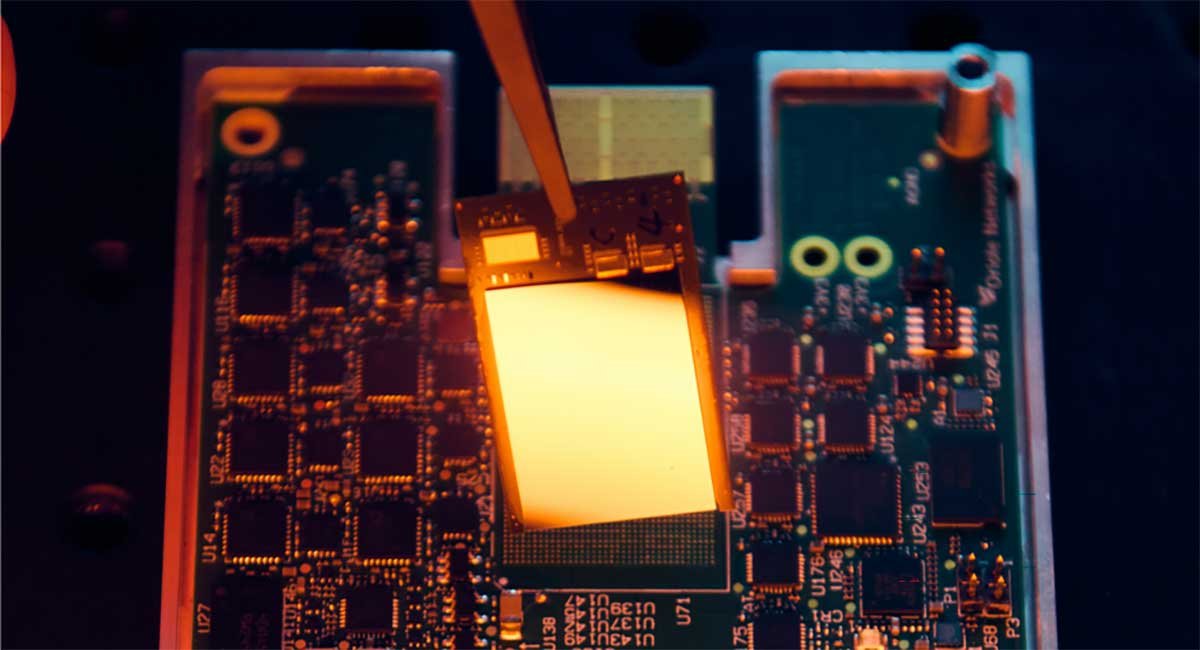
Oriole Networks has reached a major milestone in the evolution of AI infrastructure through its ongoing collaboration with AMD under the UK’s Advanced Research & Innovation Agency (ARIA) Scaling Inference Lab initiative. The partnership is focused on addressing some of the biggest challenges facing modern AI data centres, including network latency, energy consumption, and scalability.
At the centre of this effort is Oriole’s PRISM platform, a groundbreaking photonic networking technology that replaces traditional electronic switching with ultra-fast optical circuit switching. By transmitting data as light rather than electrical signals, the system dramatically improves communication between AI accelerators while reducing power requirements.
The project combines Oriole’s networking technology with AMD Instinct GPUs and AMD EPYC CPUs to explore how photonic interconnects can enhance the performance of large-scale AI clusters. According to the companies, the deployment represents the world’s first large-scale pure photonic AI network and marks the first commercial implementation of Oriole’s technology.
AMD believes optical networking could play a critical role in future AI systems. Madhu Rangarajan, Corporate Vice President of Compute and Enterprise AI Business at AMD, highlighted the significance of the approach, noting that Oriole’s nanosecond optical switching architecture introduces a fundamentally new method of connecting accelerators. The collaboration aims to demonstrate how photonic fabrics can complement AMD’s computing hardware by delivering the low-latency, high-bandwidth connectivity required for AI inference workloads.
For Oriole, the achievement represents a rapid transition from research to commercial deployment. In just three years, the company has progressed from developing the underlying technology to implementing it in production-scale environments. The company expects broader industry adoption of its accelerator-agnostic networking platform beginning in 2027.
James Regan, CEO of Oriole Networks, described the development as evidence that photonic networking is moving beyond the experimental stage. He stated that the collaboration with AMD has scaled from proving scientific concepts to deploying significantly larger systems, with performance data already demonstrating substantial gains.
Transforming Data Centre Networking
Traditional data centres rely heavily on electronic switches to move information between servers and accelerators. As AI workloads continue to expand, these networks have become increasingly strained, requiring more power and generating greater amounts of heat.
PRISM seeks to solve these issues by eliminating electronic switching from the network core. Instead, it uses nanosecond-scale optical circuits that establish direct pathways between computing resources. The result is a reported 81% reduction in core networking power consumption.
The technology also improves hardware utilisation. GPU idle times, which can reach around 60% in conventional AI clusters, can be reduced to below 1%, allowing more efficient use of expensive accelerator resources. Additional benefits include lower cooling requirements, reduced water consumption, and less dependence on complex electronic networking supply chains.
According to Oriole, these improvements translate directly into better AI performance, enabling higher token generation rates and supporting more concurrent users without requiring additional hardware investments.
A New Architecture for AI Infrastructure
Regan compared the shift toward photonic networking to the transformation brought about by specialised AI processors such as those developed by Cerebras. While previous advances focused primarily on computing power, he argues that the next major leap will come from rethinking how data moves through AI systems.
Rather than forcing data through increasingly complex electrical networks, photonic architectures are designed around the natural advantages of light-based communication. This approach could unlock the bandwidth, latency, and energy-efficiency improvements needed to support future generations of AI models.
A key advantage of PRISM is its compatibility with multiple accelerator vendors. Unlike proprietary networking ecosystems tied to specific hardware platforms, Oriole’s solution is designed to operate across diverse AI infrastructures, offering organisations a flexible path toward larger and more powerful AI deployments.
ARIA Supports Industry Collaboration
The project is being supported by ARIA’s Scaling Inference Lab, which aims to accelerate innovation in AI infrastructure through partnerships between startups and established technology companies.
Suraj Bramhavar, Program Director at ARIA, said the collaboration reflects the organisation’s mission to identify technologies capable of improving the performance and economics of large-scale AI systems. He noted that bringing together innovative startups like Oriole with major industry players such as AMD is exactly the type of ecosystem the programme was created to encourage.
As AI workloads continue to grow in size and complexity, the success of this deployment may signal a broader industry shift toward photonic networking as a foundation for next-generation data centres.