


 16–18 September 2026 | BIEC, Bengaluru
Q1. India’s electronics sector is expanding rapidly. Where do you see electronica India and productronica India fitting into this growth story?
India has already demonstrated that it can build electronics manufacturing at scale. The next challenge is to build greater depth across the value chain.
That means strengthening capability in components, semiconductors, design, PCBs, electronics manufacturing services, automation, inspection, testing and the supporting supply chain. If any one of these areas remains weak, it eventually shows up in cost, quality, reliability or speed to market.
That is where electronica India and productronica India play a relevant role.
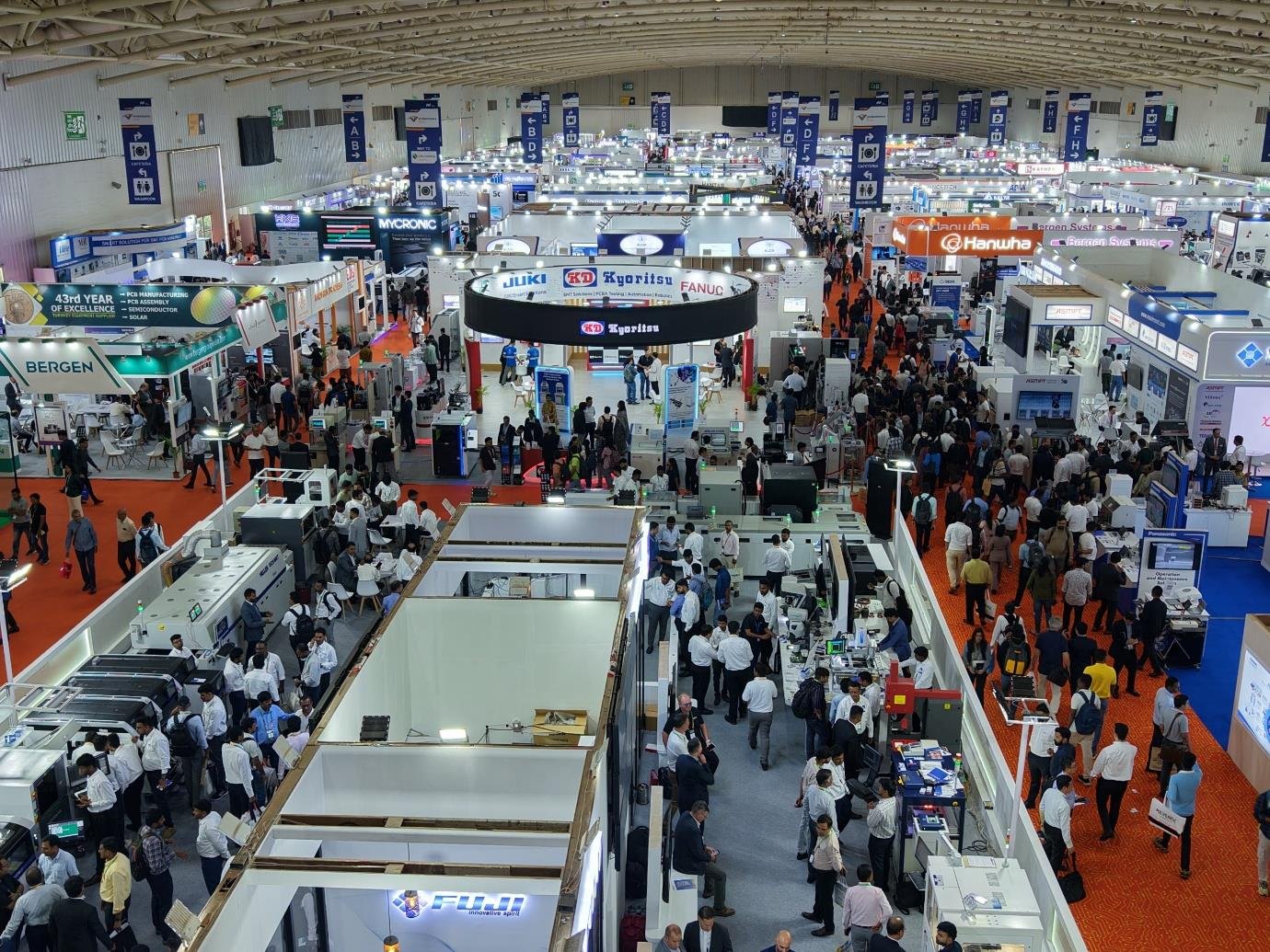
The Bengaluru edition is bringing together 770+ exhibitors from 30+ countries, covering both electronic technologies and electronics production. Importantly, within this ecosystem, electronica India features a focused set of embedded design exhibitors, reflecting the growing importance of design-led innovation in India’s electronics value chain, alongside broader electronic technologies and manufacturing solutions.
For companies, the value is in being able to compare technologies, assess suppliers, understand where manufacturing capability is moving and make more informed choices about what they source, what they localise and where they invest next.
At this stage of India’s electronics journey, those decisions matter as much as capacity addition itself.
Q2. What has fundamentally changed in the electronics industry that makes a platform like this more relevant now?
The complexity of decision-making has increased significantly.
Earlier, a company could often evaluate a component, machine or supplier largely on specifications, price and delivery. Today, one decision can affect several others.
A component choice can influence product architecture and future availability. A production system affects yield, throughput and flexibility. Testing affects reliability and compliance. Automation must make commercial sense, but it also influences how consistently a company can scale.
Then there are questions around localisation, supply-chain resilience, shorter technology cycles and future product generations.
As a result, procurement can no longer work independently of engineering, and engineering cannot be disconnected from manufacturing.
That is one reason electronica India and productronica India are increasingly relevant. They bring these functions and conversations closer together.
The companies that build a competitive advantage will be those that understand the complete manufacturing equation rather than optimise one part of it in isolation.
Q3. Why is it important to bring electronica India and productronica India together rather than view them as two separate exhibitions?
Because the Indian electronics opportunity is increasingly difficult to separate into a components conversation and a manufacturing conversation. India is working simultaneously on deeper component localisation, stronger design capability and greater domestic manufacturing capacity. OEMs, EMS companies and manufacturers therefore need to make decisions across that entire chain.
electronica India addresses what goes into an electronic product: components, semiconductors, sensors, embedded technologies and electronic systems. Within this, a key highlight is the presence of embedded design exhibitors, reflecting the increasing role of design capability in shaping next-generation electronics.
productronica India looks at how that product is manufactured: PCB production, assembly, SMT, automation, inspection, testing and other production technologies.
For OEMs and EMS companies, these decisions are closely linked. A change in component or product design can directly affect assembly, testing, automation and quality requirements.
Bringing electronica India and productronica India together therefore gives the industry a more complete view of the electronics value chain, from design and sourcing to manufacturing at scale.
Q4. With 770+ exhibitors from 30+ countries expected at the exhibition, what should senior decision-makers actually be looking for?
I would encourage them to arrive with business questions rather than a shopping list.
Most senior teams already know their existing vendors and technologies. The greater value of a trade fair is often in challenging what you currently assume to be the best option.
For example: Is there a process in your plant that can be simplified? Is there a critical component where you need a second source? Is your current level of automation still economically right for the volumes you are planning? Are there technologies that could materially improve consistency, inspection or throughput? Are there suppliers worth qualifying now rather than waiting until the requirement becomes urgent?
Senior leaders should also look beyond the immediate investment cycle.
Some technologies may not be relevant to the business this year but could become important over the next two or three years. Understanding them early gives management more time to evaluate their implications.
So I would look at the exhibition as a benchmarking exercise. How does your present operation, supplier base or technology roadmap compare with what is becoming available in the wider market?
For a CEO or business head, that perspective can be more useful than discovering any single product.
Q5. How important is international participation at the Bengaluru edition?
Electronics is inherently a global industry, so international participation adds an important reference point.
The presence of companies from 30+ countries, along with dedicated Country Pavilions from Taiwan, Germany, Japan and China, gives Indian visitors the opportunity to examine different technology and manufacturing ecosystems within one visit.
But the objective should not simply be to see foreign technology.
The more useful question is: where is global capability moving, where has Indian capability become competitive, what still needs to be sourced internationally, and where can localisation or technology partnerships make commercial sense?
Global does not automatically mean better for every application, just as domestic does not automatically mean the right fit. Companies need the ability to compare.
That becomes especially important when the investment under consideration could influence production capability for the next five or ten years.
You need a view of the market beyond the suppliers you already know.
Q6. Bengaluru has a strong technology identity. How does the location influence the character of this edition?
Bengaluru gives the exhibition a very relevant industry setting.
The region has a strong concentration of electronics design, embedded technologies, R&D, engineering, aerospace, defence and technology-led businesses. That creates a useful intersection between people developing electronic products and those responsible for industrialising and manufacturing them.
For electronica India, this creates strong relevance for design engineers, product developers, R&D teams and sourcing professionals—particularly in areas such as semiconductor design and advanced electronic system development.
For productronica India, it connects with EMS companies, manufacturing organisations, production teams and businesses evaluating PCB, SMT, automation, inspection and testing technologies.
What I find particularly important is the nature of the conversation this creates.
Discussions can move quite quickly from a product specification to questions such as: Will this work in our application? Can it be manufactured consistently? Can it scale? What will it require from our production line? How do we test it?
That makes the engagement much more useful for both visitors and exhibitors.
Q7. As India advances its ambition to become a global electronics manufacturing hub, what do you see as the next critical steps to strengthen this ecosystem?
The next phase has to be about depth and value addition.
Scale will remain important, but India also needs stronger capability across components, design, PCBs, electronics manufacturing services, automation, testing, process control, quality systems, capital equipment and supplier development.
There also needs to be a much tighter connection between product development and manufacturability.
If we want to move into more sophisticated electronics manufacturing, it is not enough to design a good product. Companies have to be able to manufacture that product repeatedly, at the required quality, at competitive cost and at scale.
This is also why supplier development becomes so important. A strong manufacturing ecosystem cannot depend on a handful of capable companies. It needs depth across multiple tiers of the supply chain.
Platforms such as electronica India and productronica India can support that process by making capability visible. Companies can see where alternatives exist, where technology gaps remain and where new supplier or technology relationships may be worth developing.
And this matters well beyond the electronics industry itself. Stronger electronics manufacturing capability has implications for automotive and EVs, industrial machinery, telecom, consumer products, healthcare devices, aerospace, defence, energy systems and smart infrastructure.
Electronics increasingly sits inside almost every major industrial value chain.
Q8. The India Electronics Conclave runs alongside the exhibition. What does it add to the overall proposition?
The exhibition and the conference serve two different purposes.
The exhibition helps you understand what technology and capability are available. The knowledge programme should help you understand the larger changes influencing why those technologies matter.
The India Electronics Conclave 2026 programme at electronica India and productronica India brings together policy, manufacturing, technology and design priorities shaping India’s electronics sector. Key sessions include the Karnataka Electronics Leadership Summit with PwC India; the ICEA Capital Goods Summit on localising capital goods, robotics, automation and testing infrastructure; the CEO Forum with ELCINA on design, IP, component ownership and the ECMS Scheme; the Exports & FTAs in Electronics Sector programme with MEDEPC; and the BPCA Tech Conference: India PCB 2.0 – Catalysed by ECMS Scheme.
The programme also features the eFuture Conference on intelligent electronics, the IEEE Standards Workshop: The Future of EDA – IEEE Standards in Action, a session on Best Practices in EMI & EMC Design and Compliance with EMIS India, the OE-A Symposium on Flexible Electronics with the VDMA Sector Group OE-A, and Engineering for Tomorrow: Design to Manufacturing
Adding a strong technology and learning dimension are the electronica India Tech Challenge pitches, where participants will design an Edge AI-powered wearable or embedded system with HackCulture, and an AI Masterclass with GrowthX/GrowthSchool, featuring two hands-on 90-minute sessions.
For me, the connection between the conference room and the exhibition floor is the important part.
You may spend the morning hearing how an industry issue is developing and then spend the afternoon speaking directly with companies addressing that issue through technology, production capability or supply.
That makes the knowledge programme much more commercially relevant than a standalone conference.
Q9. Several industry associations are involved in the programme. Why does that matter?
Electronics is far too broad for any single organisation to represent every technical and commercial issue with equal depth.
The requirements of PCB manufacturers are different from those of semiconductor companies. Exporters are dealing with different questions from production engineers. Flexible electronics, EMI/EMC, automation and power electronics each have their own technical, regulatory and commercial considerations.
That is why participation from organisations and initiatives such as ELCINA, ICEA, MEDEPC, VDMA, IEEE, JETRO and OE-A adds value to the programme.
They bring specialist communities into the discussion.
For visitors, that can help turn a broad conversation about the future of electronics into something much more specific: What does this development mean for my product, my factory, my supply chain or my market?
That level of relevance is important.
Q10. Supplier development is a recurring challenge in electronics. How does the Buyer-Seller Forum address this?
Finding suppliers is one part of the challenge. Finding suppliers with the right capability, quality systems, capacity and long-term fit is much harder.
An exhibition naturally enables discovery, but supplier development requires more focused conversations.
The Buyer-Seller Forum, scheduled across all three days, is designed as a vendor-development platform connecting qualified buyers and sellers around actual business requirements.
For a buyer, the value is in widening the supplier pipeline and identifying companies that may be worth evaluating further.
For suppliers, it offers a better understanding of what manufacturers are really looking for, whether that is a particular technology, production capability, volume requirement, quality expectation or future programme.
I think the timing is particularly relevant in electronics because supplier qualification can take time. Technical evaluation, audits, samples, testing and commercial discussions do not happen overnight.
It is far better to build those relationships before a sourcing issue becomes urgent.
Q11. What do initiatives such as the electronica India Tech Challenge bring to an established industry exhibition?
They bring a different lens to established industry problems.
Large manufacturing organisations naturally have to think about reliability, qualification, scalability and commercial viability. Start-ups, younger technology companies and independent innovators are often less constrained by the way a problem has traditionally been solved.
The electronica India Tech Challenge pitches with HackCulture, scheduled across Days 2 and 3, gives some of those ideas a place within the larger industry environment.
The value is not that every new idea will necessarily translate into an industrial solution.
The value is in exposing established businesses to different approaches and, equally, allowing emerging companies to test their thinking against people who understand manufacturing realities, qualification requirements and scale.
Innovation becomes far more meaningful when those two perspectives meet.
Q12. If you were advising an electronics company on how to approach its visit, what would you tell them?
I would tell them not to treat it as a general industry visit.
Before arriving, identify two or three questions that matter to the business.
Perhaps you have a component dependency you want to reduce. Maybe a manufacturing process has become a bottleneck. You may be planning capacity expansion, looking for alternative suppliers, evaluating more automation or trying to understand a technology that is likely to affect your next product generation.
Start there.
Then use the exhibition deliberately.
Meet existing suppliers but make time for companies you do not know. Compare Indian and international alternatives. Attend the conference sessions directly connected to your priorities. Use the Buyer-Seller Forum where it makes sense. And when the decision cuts across functions, bring colleagues from engineering, sourcing, manufacturing or quality into the discussion.
A good trade fair visit should leave you with something that has changed.
It may be a supplier shortlist. It may be an investment assumption you now need to reconsider. It may be a technology you want your engineering team to evaluate. It may simply be a better question for the management team to discuss.
That is a much better measure of value than the number of booths visited.
Q13. Finally, what would you like the industry to take away from electronica India and productronica India 2026?
I would like companies to leave with a clearer view of where electronics technology and manufacturing capability are heading, and what that means for their own business.
The Bengaluru edition is expected to bring together 770+ exhibitors from 30+ countries, dedicated Country Pavilions and a three-day knowledge programme covering some of the issues that are currently shaping electronics design, sourcing and manufacturing. Importantly, it also brings together semiconductor design innovation with the broader electronics manufacturing ecosystem, creating a more complete view of how design and production are converging.
But scale by itself is not the outcome.
What matters is what companies do with that access.
If an engineering team discovers a better technical approach, if a manufacturer identifies a technology worth evaluating, if a sourcing team finds a supplier it should begin qualifying, or if a leadership team recognises a market shift early enough to respond, then the platform has created value.
I would like people to leave with sharper questions and a clearer next move.
Because ultimately, the most useful outcome of an industry platform is not how much you managed to see over three days. It is whether you understand something differently when you leave, and whether that changes what you do next.
_________________