



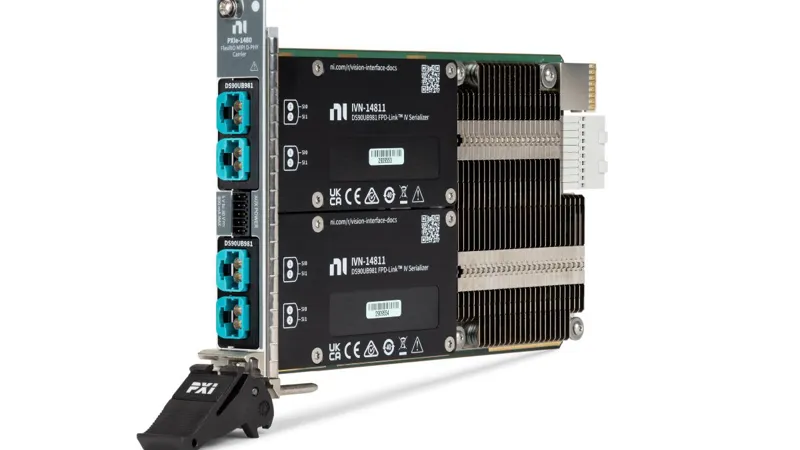
Emerson has launched a new modular testing architecture aimed at helping automotive engineers manage the growing complexity of software-defined vehicles and advanced electronic systems.
The company’s latest automotive vision solution is built on NI technology and combines a high-performance FPGA core with interchangeable serializer/deserializer (SerDes) interface devices. The design enables engineers to adapt test systems to changing display and camera interface requirements without the need for extensive hardware redesigns.
The launch expands the capabilities of Emerson’s NI PXI platform, positioning it as an open and flexible foundation for high-performance automotive testing. At the centre of the solution is the NI PXIe-1480 FlexRIO multiprotocol vision carrier module, which supports interchangeable interface devices for testing automotive displays and cameras.
Initially, the platform will support FPD-Link IV, a high-speed automotive video interface widely used in advanced driver assistance systems (ADAS) and in-vehicle display applications.
As vehicle manufacturers increasingly adopt centralised electronic control unit (ECU) architectures, engineers face the challenge of validating multiple high-speed interfaces across more complex systems. Traditional display testing methods, which often rely on cameras or manual visual inspection, can limit scalability and introduce inconsistencies.
Emerson said its PXI-based modular approach addresses these issues by providing a direct connection to ECU and display SerDes input/output interfaces. This enables automated, deterministic testing, helping to improve test coverage, streamline validation processes and enhance repeatability.
“The increasing complexity of automotive electronics requires a more flexible and scalable approach to validation,” said Sam Burhans, chief product manager for Emerson’s test and measurement business. “This modular architecture allows engineers to adapt their test systems to evolving interface standards without redesigning their entire setup.”
The NI PXIe-1480 carrier module serves as the foundation of the platform, allowing users to deploy interface devices tailored to specific testing requirements. While the initial release focuses on display testing, Emerson said it plans to introduce additional interface devices later this year to support a wider range of camera and display protocols.
The system is intended for automotive validation and production testing environments, including Tier 1 suppliers and original equipment manufacturers (OEMs). Potential applications include in-vehicle infotainment systems, ADAS technologies and autonomous driving platforms.
The introduction of the modular architecture reflects the automotive industry’s broader shift towards more software-driven vehicle designs, which require flexible and scalable testing solutions capable of adapting to evolving communication standards and system architectures.