



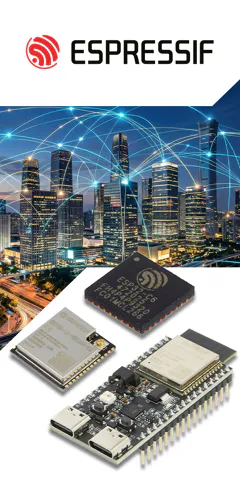
 The Internet of Things market is developing extremely dynamically, and with it, the requirements for end devices are growing. Designers today expect not only reliable wireless connectivity but also a high level of security, energy efficiency, and support for multiple communication standards. The ESP32-C6 circuits and modules from Espressif, which combine modern communication technologies with an efficient RISC-V architecture and advanced data protection mechanisms, are the answer to these needs.
The concept of IoT (Internet of Things) is entering our lives and systematically gaining more trust. Solutions based on this technology can be found in household devices such as smart refrigerators, as well as in office work comfort management systems. Thanks to Wi-Fi connectivity, users can easily monitor and control the operating parameters of devices using mobile applications. This includes air quality, temperature, humidity, or energy consumption. To ensure the proper functioning of such applications, apart from the obvious components such as various sensors and control systems, these types of systems must be connected to the local network. Typically, this means that the device needs a Wi-Fi module to send the necessary data to the server, from which applications retrieve it and make it available to users.
Currently, there are 8 Wi-Fi standards that offer different frequency bands and maximum data transmission speeds. Subsequent versions introduced new features, skillfully combining performance with energy efficiency (depending on how the device is used). In the case of IoT devices, the WiFi 6 standard is the most desirable, as most IoT devices do not require the bandwidth offered by WiFi 7. At the same time, WiFi 6 provides access to mechanisms such as OFDMA, which streamline the handling of a large number of devices communicating simultaneously within one network.
ESP32-C6 – strongest features
TME offers ESP32-C6 circuits and modules built using them. They integrate WiFi 6 2.4GHz communication, Bluetooth®5 (BLE), and the 802.15.4 protocol, achieving industry-leading RF performance, making them an attractive choice for IoT applications. Here are the key features of this module:
- OFDMA mechanism for uplink and downlink communication;
- Support for MU-MIMO for downlink traffic;
- Target Wake Time (TWT) feature of the 802.11ax standard for battery-powered devices.
ESP32-C6 consists of a powerful 32-bit RISC-V processor with a clock speed of up to 20MHz. It has 320KB of ROM memory, 512KB of SRAM, and works with external flash memory. Additionally, it is equipped with 30 (QFN40) or 22 (QFN32) programmable GPIO inputs/outputs with SPI, UART, I2C, I2S, RMT, TWAI, SDIO, PWM control, 12-bit analog-to-digital converter (ADC), and a built-in temperature sensor.
Higher security standard
ESP32-C6 is the first SoC chip based on the RISC-V architecture that has obtained the PSA-L2 certificate. This means that it raises security standards, demonstrating its robustness in securing IoT applications and proving that RISC-V is a reliable architecture in security-sensitive applications. The PSA Level 2 certificate proves that ESP32-C6 meets strict security requirements. It is equipped with a range of advanced security features, such as:
- Physical memory protection (PMP) and access permission management (APM),
- Digital signature of peripheral devices,
- Secure boot,
- Flash memory encryption,
- Hardware cryptographic accelerators,
- Secure JTAG mode.
Thanks to compliance with the most important upcoming regulations, such as the EU Cyber Resilience Act (CRA) and the Radio Equipment Directive (RED), the American Cybersecurity Improvement Act, and the British PSTI-PSA certification, Espressif products are resistant to future challenges and fully compliant with evolving global requirements.
TME Offer
TME’s offer includes ESP32-C6-WROOM and ESP32-C6-MINI modules, as well as dedicated development kits. The modules provide a ready implementation of wireless interfaces, while the development kits allow for quick verification of project assumptions and the start of software development even before the development of the target hardware.