





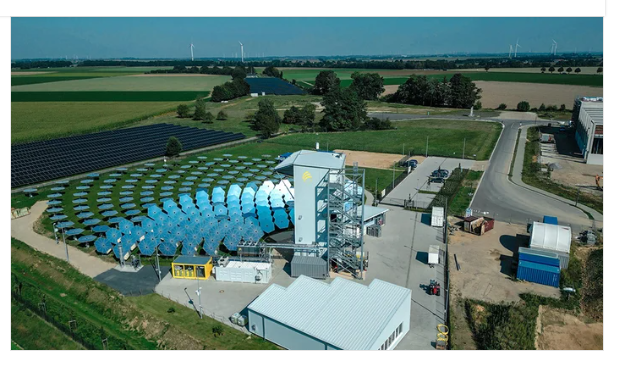
Liquid fuels from light and air: it’s no longer just an idea. Swiss startup Synhelion has commissioned a facility that concentrates solar energy so efficiently that the energy produced can be used to produce fuels on an industrial scale.
The principle of burning glass applied to solar towers
In fact, it’s all quite simple. After all, almost everyone is familiar with the principle of burning glass. If you hold a magnifying glass up to the sun and fix its focal point on a piece of paper, the paper quickly begins to burn. The concentrated solar energy becomes so hot that it reaches the flash point.
Solar tower power plants use this principle. Using mirrors and a tower much higher than the height at which you can hold a burning glass, the adjustable mirrors direct the reflected solar rays onto the tower. In Jülich, North Rhine-Westphalia, such a solar tower has been rising about twenty meters since June 2024. At its foot is an armada of mirrors, called heliostats. These can be oriented to concentrate the reflected solar rays onto a point at the top of the tower. This is where the receiver is installed, converting the solar energy into high-temperature industrial heat. The concentrated solar energy generates temperatures of over 1,550°C. “It’s a real world record,” explains Carmen Murer. She should know this firsthand, as she’s a press officer for the Swiss company Synhelion.
Solar fuel?
Synhelion is a spin-off of the Swiss Federal Institute of Technology (ETH) and Zurich. The successful synthesis of hydrocarbon molecules from concentrated solar energy was already successful in the laboratory in 2010. In 2014, solar kerosene was produced for the first time in the laboratory, exclusively from CO₂ and H₂O. In 2016, the two scientists, Drs. Gianluca Ambrosetti and Philipp Furler, founded Synhelion AG with the expansion “Solar Fuels”. Following successful field experiments, construction of “DAWN,” the first demonstration plant for the industrial production of solar fuels, began in 2022. Jülich was also chosen as the location due to Synhelion’s close collaboration with colleagues at the German Aerospace Center (DLR). There is also a second solar tower, unique in Northern Europe, used by DLR scientists for research purposes.
The captured heat is injected into a thermochemical reactor. Syngas, consisting of H2 and CO, is then produced from CO2, water, and methane. This syngas is liquefied using a gas-to-liquid process. The liquid solar crude oil is then processed in a conventional refinery. In addition to the main component kerosene, gasoline and diesel can also be produced this way.
CO2 and methane are supplied by a biogas plant at the Jülich site. In the future, it is planned to supply the required carbon source from industrially filtered CO2. A direct air capture (DAC) plant of this type was developed by Climeworks, also a start-up from the Swiss Innovation Hub ETH Zurich.
Energy not immediately used is transferred to an energy storage unit with a ceramic interior and is available from sunset. The young Swiss entrepreneurs thus ensure continuous production, 24/7, without interruption. According to Synhelion, it is also around ten times cheaper than a comparable battery-powered electric power source.
“Synhelion has created or developed four technology areas,” explains Carmen Murer, describing the Swiss team’s innovative strength. “We developed the heliostats, the solar receiver, the thermochemical reactor, and the heat storage unit.” The Swiss have filed a total of 20 patent families to protect their inventions.
“For the time being, the world will continue to rely on liquid fuels. In aviation, for example, battery-electric propulsion is not yet sensible. Our renewable solar fuels, on the other hand, can directly replace fossil fuels and, when burned, only emit the amount of CO₂ absorbed during their production.”
Future-proof technology for a more sustainable world
DAWN and the RISE tower solar power plant, which will be built in Spain starting in 2025, are still relatively small plants. But Carmen Murer is certain: “Our technology is globally scalable, and our renewable fuels offer an important solution in the fight against climate change. However, we will gradually increase our capacity, because without it, the plants would not be financially viable.” Synhelion plans to produce around one million tons of kerosene within ten years. “Initially, we will build and operate the plants ourselves. Afterwards, Synhelion will act solely as a technology supplier, while the energy companies will take over production. The investment in building these plants is very high. However, the subsequent production costs are very low,” explains Carmen Murer, describing the obstacles and opportunities for rapid expansion of this technology.
Products combining light and air are already in high demand: Swiss International Air Lines is just one of many cooperation partners of Swiss innovators. Concrete purchasing agreements have been concluded with the aircraft manufacturer Pilatus. Solar diesel should enable a Swiss operator of historic steamships to make progress. Pure thermal energy is also inspiring new ideas: the cement manufacturer Cemex is already conducting successful trials with solar cement. But for now, the Swiss are primarily interested in the dream of flying, thanks to light and air.