



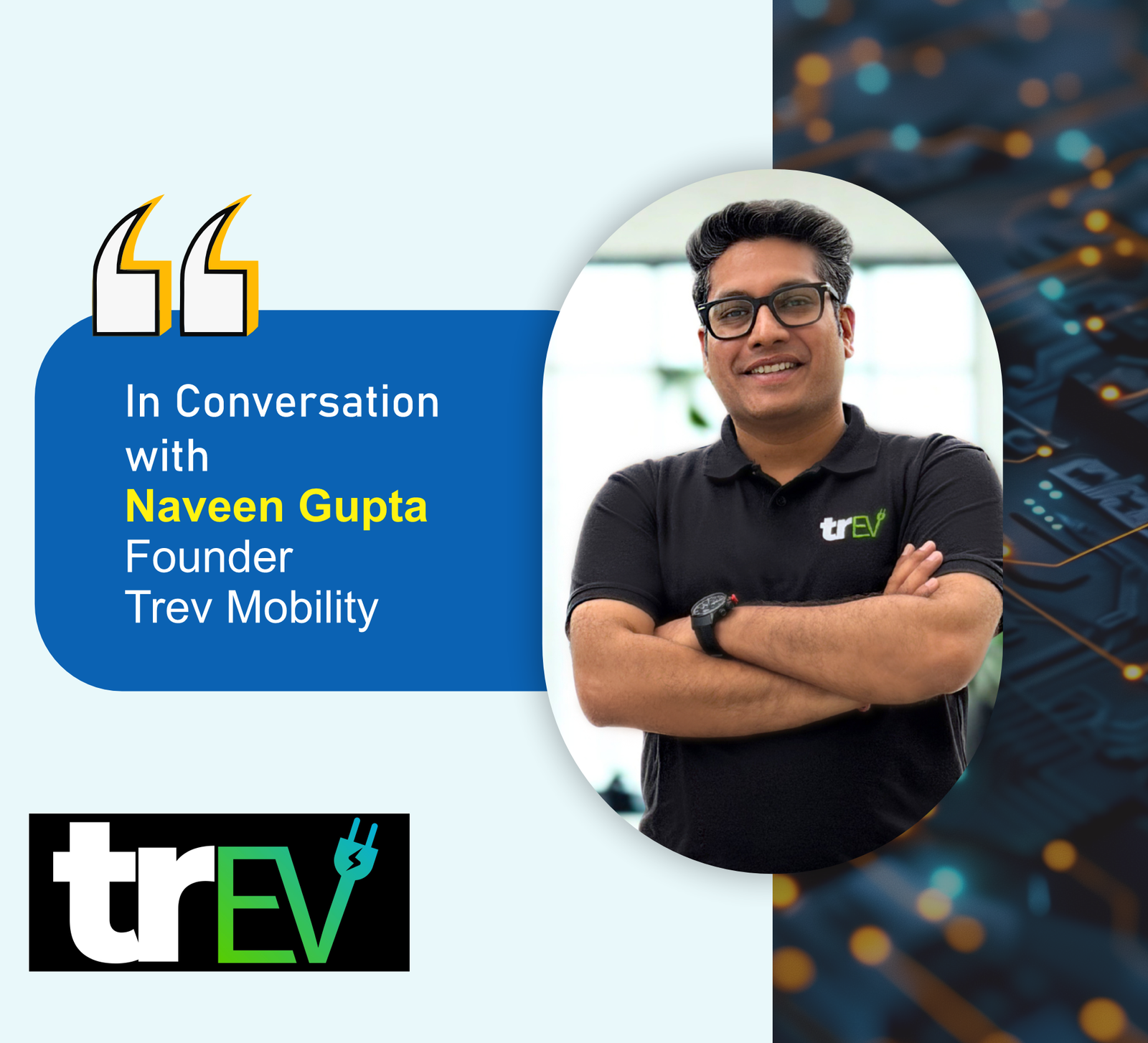
In-Conversation questionnaire tailored for Naveen Gupta, Founder, Trev Mobility, based on the company's growth from a two-car startup to a fleet of over 100 EVs across Delhi NCR.
Here its a Full Interview:
Trev Mobility has grown from a two-car startup to operating a fleet of over 100 electric vehicles across Delhi NCR. What inspired you to enter the EV mobility space, and what were the biggest challenges during the early days?
The idea for Trev came from a simple observation: people wanted a better commuting experience, but traditional mobility options often fell short on reliability, comfort, and consistency.
When we started, EVs were still relatively new in the commercial mobility ecosystem. There was excitement around the technology, but not enough focus on building a sustainable business around it. We believed electric vehicles would eventually become the default choice for urban mobility because the economics and environmental benefits both made sense in the long run.
The early years were challenging. Charging infrastructure was limited, customers had questions about EV reliability, and fleet financing wasn’t as straightforward as it is today. We had to build trust on multiple fronts—customers, drivers, partners, and investors.
What helped us grow was staying focused on operations. Instead of chasing rapid expansion, we concentrated on delivering a reliable experience every single day. That discipline has played a big role in helping us scale from two cars to a fleet of over 100 EVs today.
The EV ecosystem in India has evolved significantly over the past few years. How has Trev Mobility adapted its business model to keep pace with changing customer expectations, technology, and government policies?
The biggest change we’ve seen is that customers no longer choose EV mobility because it’s new. They choose it because they expect a reliable and premium experience.
As the ecosystem matured, we shifted our focus from simply operating EVs to building a service layer around them. Customers today expect punctuality, professional chauffeurs, transparent pricing, clean vehicles, and responsive support. Whether the vehicle is electric or not becomes secondary if these fundamentals are not met.
On the technology side, vehicle range, battery performance, and charging networks have improved significantly. Policy support has also helped accelerate adoption and strengthen the ecosystem. We have continuously adapted by improving fleet utilization, optimizing charging schedules, and using operational data to make smarter decisions.
Ultimately, our business has evolved around customer expectations rather than around the vehicles themselves.
Fleet management is a critical aspect of shared mobility. What strategies have you implemented to ensure operational efficiency, vehicle uptime, and customer satisfaction while scaling your EV fleet?
In fleet operations, success is usually decided long before a customer books a ride.
A lot of our effort goes into preventive planning rather than reactive problem-solving. We closely monitor vehicle health, charging schedules, driver allocation, and route planning to maximize uptime.
For EV fleets specifically, charging management is critical. A vehicle sitting idle at a charging station is not generating revenue, so efficient scheduling becomes extremely important. We also maintain strong operating discipline around vehicle maintenance and driver training.
Customer satisfaction is ultimately the result of operational consistency. If the car arrives on time, is clean, the chauffeur is professional, and the ride experience is smooth, customers come back. That’s been our approach from day one.
Charging infrastructure remains one of the biggest concerns for EV adoption. How has Trev Mobility addressed this challenge, and what role do partnerships play in strengthening your operations?
Charging infrastructure has improved significantly compared to where the industry was a few years ago, but it remains one of the most important operational considerations for any EV fleet.
At Trev, we have built our operations around planned charging rather than depending entirely on public infrastructure. We use a combination of dedicated charging arrangements, strategic charging schedules, and operational planning to ensure vehicles remain available when customers need them.
Partnerships play a crucial role in this process. Whether it’s vehicle manufacturers, charging providers, technology partners, or infrastructure operators, scaling EV mobility requires collaboration across the ecosystem.
No single company can build the future of mobility alone. Strong partnerships help improve reliability, efficiency, and ultimately the customer experience.
Sustainability is at the heart of electric mobility. Beyond reducing carbon emissions, how is Trev Mobility contributing to creating a more sustainable and inclusive transportation ecosystem in India?
Sustainability is often discussed only in terms of emissions, but for us it is equally about building a sustainable mobility business.
A mobility solution can only create long-term impact if it works for customers, drivers, and operators at the same time.
By operating electric vehicles at scale, we are helping accelerate familiarity and confidence around EVs. Every successful ride contributes to greater acceptance of electric mobility among consumers.
We also focus on creating livelihood opportunities for chauffeurs and building a culture around professional service standards. A more sustainable transportation ecosystem is not just cleaner—it is also more efficient, more accessible, and more dependable for the people who use it every day.
Looking ahead, what are Trev Mobility’s expansion plans? Are there ambitions to enter new cities, diversify services, or integrate emerging technologies such as AI, telematics, or battery swapping?
Our primary focus is on building a stronger and more efficient mobility platform.
We see significant opportunities within premium electric mobility as customer expectations continue to evolve. While geographic expansion will always be evaluated carefully, we believe sustainable growth is more important than growth for its own sake.
Technology will continue to play a larger role in fleet operations. Areas such as telematics, predictive maintenance, utilization optimization, and AI-driven operational intelligence can significantly improve efficiency and customer experience.
Our approach has always been to adopt technology where it creates real value rather than following trends. The objective remains the same: deliver a more reliable and seamless mobility experience.
As an entrepreneur who has successfully built and scaled an EV mobility startup, what advice would you offer to aspiring founders looking to build businesses in India’s rapidly growing clean mobility sector?
My biggest advice would be to focus on solving a real customer problem rather than building around a trend.
The clean mobility sector offers tremendous opportunities, but long-term success comes from operational excellence, not headlines. Customers do not choose a service because it is electric; they choose it because it is reliable, convenient, and valuable.
Founders should spend time understanding unit economics, customer behaviour, and execution. The businesses that will endure are the ones that create genuine value and maintain discipline as they scale.
India’s EV ecosystem is still evolving, which means there is enormous room for innovation. But sustainable businesses are built one customer, one ride, and one operational improvement at a time.