


By Paul Duffy, Cisco and Chair of the Field Area Network Working Group at the Wi-SUN Alliance
The global electric utility industry is undergoing significant evolution. As first-generation Advanced Metering Infrastructure (AMI 1.0) systems reach the end of their operational life, utilities are shifting to the next frontier: AMI 2.0. But what exactly is AMI 2.0—and how does the Wi-SUN Field Area Network (FAN) make this transition possible?
Let’s explore.
A Look Back: What AMI 1.0 Delivered
Since its introduction around 2010, AMI 1.0 has enabled large-scale electric meter deployments across millions of households and businesses. Its primary function has been the automated collection of electricity usage data, typically in intervals ranging from 5 to 60 minutes, for billing purposes.
But that’s not all. AMI 1.0 systems also provided:
- Outage and restoration notifications enabling fast location, isolation and restoration of power outages (FLISR).
- On-demand meter readings and remote connects/disconnects.
- Monitoring of meter health, performance, and firmware updates.
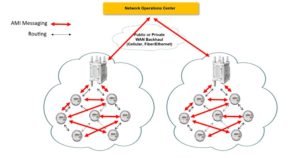
Communication in AMI 1.0 environments has mostly followed a meter-to-headend model where meters send data directly to the utility headend (NOC). Networks have commonly used FSK based mesh technologies with data rates in the 100s of kbps range, often built on proprietary IEEE 802.15.4 sub-GHz protocols. More recently, the industry has been converging on the interoperable Wi-SUN FAN standard, with LTE (private and public) often used complementarily as the backhaul connectivity to the headend.
The Shift to AMI 2.0
Today’s utilities need more than just billing data. With the advent of distributed energy resources (DERs), electric vehicles (EVs), and increasing grid complexity, AMI 2.0 emerges as a critical platform for intelligent, distributed grid management. The AMI 2.0 meter has evolved into a powerful Edge Intelligence/AI platform able to support all of the capabilities of AMI 1.0 and introduces powerful new features:
- Appliance-level consumption insights via disaggregated energy data.
- Waveform analysis at the edge to detect early signs of grid equipment failure.
- Local grid intelligence—meters and transformers working together to support EV charging, DER optimization, and overload protection.
These advancements require a fundamental shift in the way data is collected, processed, and transmitted. AMI 2.0 communication networks must:
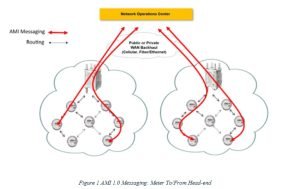
- Support local, low-latency (“peer-to-peer”) messaging within transformer neighbourhoods.
- Deliver significantly higher bandwidth to accommodate richer data flows needed for Edge Intelligence/AI.
- Enable larger and more frequent firmware and app updates to edge devices.
How Wi-SUN FAN Enables AMI 2.0
Enter Wi-SUN Field Area Network (FAN) — an open, interoperable, IPv6-based mesh networking specification built on the IEEE 802.15.4 standard, also providing enterprise class security. Wi-SUN FAN is purpose-built for large-scale utility and smart city deployments, offering the scalability and performance needed for AMI 2.0.
The latest version, FAN 1.1, introduces major enhancements:
- Data rates up to 2.4 Mbps
- Low-power operation for battery-based devices
- Dynamic link speed negotiation
- Expanded support for global 800 and 900 MHz bands
Why Wi-SUN FAN is ideal for AMI 2.0
In addition to the enhancements to data rate, power savings, and link and spectrum advantages, Wi-SUN FAN 1.1 also offers the following:
- Operates in license-free spectrum, avoiding costly cellular fees.
- Supports local messaging to minimize latency, reduce headend round trips.
- Eliminates cellular session overhead for improving efficiency.
- Offers robust interference mitigation via frequency hopping and adaptive routing.
- Provides city-scale reach through multi-hop mesh (tens of kilometers).
- Provides fast network reformation following an outage/restoration event.
- Supports both electric (mains) and gas (battery) metering on a unified network.
- Edge Intelligence/AI developer friendly (familiar IP technology).
- Enables multicast firmware updates, simplifying edge device management.
Final Thoughts
As utilities move toward smarter, more dynamic grid operations, AMI 2.0 is not just an upgrade—it’s a transformation. And Wi-SUN FAN 1.1 provides a high-performance, cost effective, and future-ready communications foundation to make that transformation successful.