


Designing an isolated DC/DC auxiliary power supply today requires a careful balance between speed and optimization. Engineers are expected to deliver faster development cycles with minimal risk, while also meeting increasing demands for efficiency, compactness, thermal performance, and cost control. The decision between using a ready-made module or developing a discrete topology sits at the heart of this challenge.
Module vs. Discrete Topology – Key Considerations
For many development teams, DC/DC modules are the preferred starting point. Their integrated nature significantly reduces engineering effort, shortens design timelines, and simplifies compliance and validation processes. When working with limited production volumes or tight deadlines, modules often provide the most efficient path to market.
However, as production scales, priorities evolve. Cost per unit, thermal efficiency, and tighter system integration become more critical. In such cases, discrete DC/DC designs offer clear advantages. By tailoring elements such as transformer characteristics, switching frequency, and PCB layout, engineers can achieve higher efficiency and improved thermal behavior while reducing long-term costs.
A typical economic crossover point occurs around 50,000 units. Below this level, modules are usually more cost-effective. Beyond it, discrete solutions tend to provide better value.
It’s also important to recognize the technical complexity involved. Power electronics design requires expertise in magnetics, switching dynamics, parasitic effects, isolation, and EMC. Since not all teams have deep analog experience, modules remain popular because they encapsulate much of this complexity into a proven solution.
RECOM’s Platform Concept: Bridging the Gap
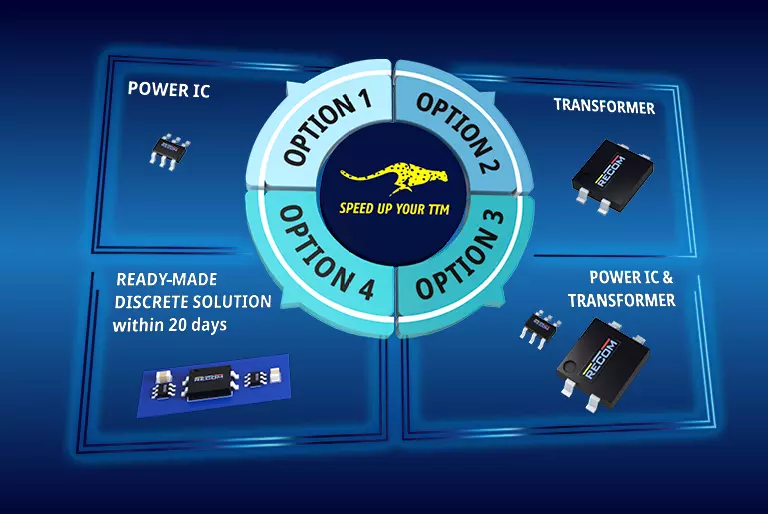
A modern approach is emerging that blends the strengths of both modules and discrete designs. RECOM introduces an IC + transformer platform that simplifies the transition between these two worlds.
This architecture is built around three core components:
- A primary-side driver IC
- A transformer (standard or customized)
- Secondary-side rectification and control circuitry
Together, these elements form a compact, isolated power supply. The primary IC generates the switching signal, the transformer ensures energy transfer and isolation, and the secondary stage delivers a stable DC output.
Many reference designs require only minimal external components, keeping the bill of materials low while still allowing flexibility. Engineers can implement various topologies such as push-pull, full-bridge, or LLC, depending on application needs.
Advantages for Development Processes
One of the most valuable aspects of this approach is the co-optimization of ICs and transformers. By offering these components as a matched solution, development becomes more predictable and efficient.
Key benefits include:
- Fewer design iterations
- Faster validation and testing cycles
- Improved system reliability
- Simplified handling of isolation, voltage levels, and power transfer
Instead of building everything from the ground up, engineers start with a pre-aligned foundation. This significantly reduces development time while preserving the flexibility needed for application-specific tuning.
Market Perspective and Strategic Value
From a market standpoint, this unified approach offers a clear advantage. By providing both complete modules and discrete solutions within the same ecosystem, RECOM enables a seamless transition across different stages of product development.
This creates a practical workflow:
- Begin with a module for rapid prototyping and quick market entry
- Transition to a discrete design as volumes increase and cost optimization becomes essential
Rather than treating modules and discrete designs as separate paths, this strategy connects them into a continuous development journey. It reduces redesign effort and maintains consistency across product generations.
Ultimately, the decision is no longer about choosing one over the other; it’s about selecting the right approach at the right time.
Typical Applications of Discrete DC/DC Converters
This design methodology is particularly beneficial in applications that require compact, isolated auxiliary power supplies. Common use cases include:
- Gate driver supplies for IGBTs, MOSFETs, and SiC devices
- Distributed power systems
- Industrial and high-performance electronics
In these scenarios, precise switching behavior, strong isolation, and reliable thermal performance are essential. A coordinated IC and transformer solution ensures consistent operation and simplifies scaling into mass production.
Conclusion: Toward Scalable Power Supply Strategies
The future of DC/DC power design is not about replacing modules with discrete solutions, but about enabling flexibility. Different project phases demand different priorities.
- Early-stage development benefits from speed and simplicity
- High-volume production demands cost efficiency and optimization
The ability to move smoothly between these stages is becoming a key competitive advantage. By combining integration with customization, IC + transformer platforms offer a powerful bridge between rapid development and long-term efficiency.
In an increasingly demanding market, scalable and adaptable power supply strategies are no longer optional; they are essential for success.